
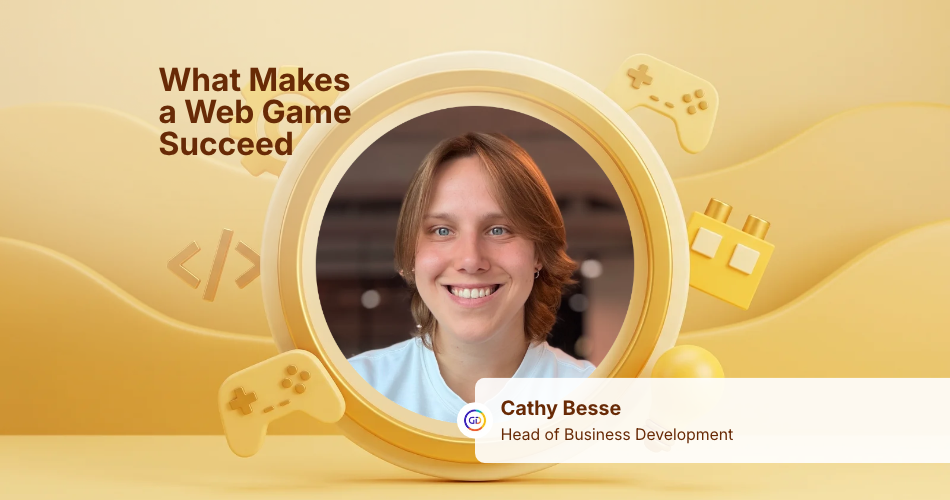

For anyone who has ever wondered what happens after a game is submitted, who reviews it, what they look for, and how a title makes its way from a developer’s hard drive to thousands of publishing portals, Cathy Besse has the answers.
Cathy is Head of Business Development within GameDistribution’s Developer Relations team, working directly with studios around the world to help their games find the right audience on the web.
With Gamescom 2026 coming up in Cologne from August 26 to 28, Cathy will be in the B2B area and available to meet developers in person. Whether you want to talk about distribution, game monetization, or what it takes to build a lasting presence on the web, Cathy is definitely someone worth having a conversation with.
Ahead of the event, Cathy sat down with us to share a perspective on the state of web gaming, what helps games succeed across platforms, and some of the common mistakes developers make.
GD: How have player expectations changed over the past two or three years?
“Players have way less patience now because there are so many options to choose from. Player attention spans have gotten much shorter over the past couple of years because people are exposed to so much content online. They expect a dopamine hit within the first few seconds of seeing a game, or they will immediately click to the next game. They want instant stimulation, easy to understand mechanics, and a feeling of quick mastery. Because players won’t stick around if a game isn’t intuitive right away, seamless onboarding has become one of the most critical factors over the last few years.“
GD: What makes a game technically and creatively strong enough to succeed across different platforms and markets?
“On the technical side, it starts with choosing a cross platform engine like Unity or Defold that lets you build for all kinds of platforms, whether it is PC, mobile, web, or consoles, all from a shared codebase. That way, you don’t have to rebuild the game from scratch for each target platform. Defold is especially powerful for the web because it can build pure HTML5 games with tiny file sizes and fast load times, while Unity offers great flexibility across PC, mobile, and WebGL. Either way, you need to plan for cross platform development before starting by designing scalable graphics and flexible controls for touch, keyboard, and gamepad so the game adapts easily across any platform.
Creatively, we’re seeing a lot of indie games hitting the top of the charts alongside AAA titles because they focus on clear mechanics, a strong fun factor, and social or co-op features that keep players coming back. Games like PEAK and Meccha Chameleon are good examples of that.
Strategically, the best advice I can give is to focus on one primary market first. Do the research, test thoroughly, and maximize your success there before trying to expand. Every platform has a different audience, different hardware requirements, and different player expectations. You always need to adapt accordingly.”
GD: What technology trends do you think will have the biggest impact on web gaming over the next year?
“Two things stand out. The first is AI. We see plenty of submissions now with obvious AI elements, which shows how accessible the tools have become. But there’s an important distinction to make: AI should speed up your production, not replace your creative core. At the end of the day, players just want a game that is fun. Real innovation comes from human ideas and thinking outside the box. The real winners will be the studios that use AI as their sparring partner to test concepts, refine ideas, and execute faster, while keeping human creativity in charge of the vision.
The second is user-generated content. Roblox and Fortnite proved how powerful player-created content can be, and the web is actually the perfect environment for it. Browsers have zero friction, so if you give players in-game creation tools or level editors, they become your content creators and your biggest promoters. It keeps the game fresh, builds a real community, and gives players a genuine reason to return. We’re expecting more studios to start building those options in.”
GD: Beyond strong gameplay, what makes a game attractive from a distribution perspective?
“Publishers look at a few key performance indicators beyond core gameplay:
Localization: If your game has a lot of text, localizing it is key to reaching global markets and unlocking higher LTV.
Session Length: Web publishing platforms want to keep users on their websites, so having at least 20 to 30 minutes of gameplay depth is important.
Retention Features: Features like daily login rewards, streak bonuses, and daily challenges give players a reason to return to the site and play again.
Monetization Setup: A balanced monetization structure using a mix of rewarded video ads, interstitials, and banners is crucial because strong revenue potential is always a major selling point.“
GD: What do you see as the biggest growth opportunities for game creators right now?
“Making full use of AI tools, in some form, is the biggest opportunity most developers aren’t fully taking advantage of yet. Think about using it as your sparring partner to fine-tune your ideas, create quick prototypes, run market research, or iterate on ad campaigns. There are countless possibilities to implement AI to improve your work processes. The game creators who win will be the ones who let AI speed up their execution so they can focus on their vision and make a great game.”
GD: What advice would you give developers who want to build long-term relationships with GameDistribution?
“A great partnership rests on trust, and transparency. There is no secret formula for web gaming success; it comes down to blending your game with everything we bring to the table. We have deep market expertise, massive gaming portals like Spil Games and Admeen, strong relationships with external publishers, and tailored advertising solutions.
Also, we blend our services with your studio to find that sweet spot and make your game successful. We want to elevate your business and give you the freedom to thrive, both with us and across the wider industry. That means absolute honesty: if a game is better suited for another path, we will tell you directly. Ultimately, when we find success together, we use that win as a foundation to build on top of and scale even further.”
GD: What was the first game that made you passionate about gaming?
“The first game that really got me hooked was Habbo Hotel. I spent countless hours playing, making friends, and running self made mini games inside the hotel rooms. It is pretty funny and special that I ended up working for the company that owns Habbo Hotel today!”
GD: What’s one small thing that can instantly improve your day?
“There are so many small things that can instantly make my day better! A big cappuccino in the morning made by my partner, a delicious sandwich made with freshly baked bread, a quick call with my work bestie Sabina, a game studio sharing a new prototype for feedback, seeing one of our new releases start taking off, a colleague bringing their dog to the office, or simply smiling at a stranger and getting a smile back!”
Meet Cathy at Gamescom 2026
For developers wondering how to get their titles in front of a network of 4,800+ publishing portals, how monetization works on GameDistribution, or what it takes to grow a game’s reach across the web, this is an opportunity to talk it through in person.
Cathy will be at Gamescom 2026 in Cologne, from August 26 to 28, in the B2B area. Those interested can schedule a meeting with Cathy and bring any questions they might have.